
After Awakening
Spiritual crisis, post-awakening orientation, and why self-realization is only the beginning

“Shiv, I find myself in a strange headspace these days. The spiritual ambition that has driven this identity for decades has fallen away - and in its place there is a vacuum. I thought the dissolution of the spiritual ego would bring a sense of ease and contentment. But this doesn’t feel like ease or contentment. It doesn’t feel anxious either. It feels like - nothing. Just a dull, gray, pointless nothing. I don’t seem to care about anything these days. Even generating the motivation to ask this question has taken a lot out of me. I mean no offense, but I don’t actually care if you respond to me or even read this. That’s how apathetic I feel.”
.
***
.
Enlightenment inevitably turns into slow suffocation. Too much awareness coupled with a dysregulated nervous system leads to a state known as Zenbyo 禅病 in Japan - Zen sickness.
Contrary to what most people think, this isn’t an avoidable phenomenon. It’s a rite of passage. And it can visit not once, but at multiple points along the spiritual journey. Each time a significant threshold of realization is crossed, it is followed by a period of flow and freedom in the immediate aftermath - and yet over time, this freedom may give way to a restlessness, an emptiness or a dread that becomes all-consuming.
The 17th century Zen master, Hakuin Ekaku, who coined the phrase ‘Zen sickness’ described his own process in the following manner:
“After my great satori, I was filled with boundless energy — then came the collapse. My limbs grew weak, my chest burned, and my thoughts scattered like autumn leaves. I believed I was dying. The joy of enlightenment turned into unbearable torment. The doctors were useless. Only after meeting a Taoist hermit who taught me to breathe again did I recover.”
I am familiar with the sickness having experienced it four times in my life. But I do not see it as a disease in the traditional sense of the word. It is more akin to a withdrawal response.
Enlightenment is nothing more than the sobering up of awareness from the hallucinatory projections of the mind. These projections are not only mental but are neurochemical and produce real psychosomatic impacts on the nervous system. The nervous system becomes entrained to normalize certain patterns of trauma, behaviour, identification, and addiction, and when these patterns become suddenly disrupted - what feels like relief in the aftermath quickly turns into a sense of crisis as the nervous system struggles to adapt to sobriety.
It is not unlike the tremors recovering alcoholics feel when they first give up the drink - with symptoms that may range from mild to life-threatening depending upon the person. Sobriety may be overwhelmingly positive in the long run, but in the short-term can feel like a survival crisis to the nervous system.
The problem with non-dual teachings and the culture that has proliferated around them - is that their very denial of duality and separation sabotages any prerogative within the practitioner for self-care - since there is “no separate self” to care for. This is a problem that has plagued other austere contemplative practices as well, such as Zen. Because what they fail to recognize is that this human ego - even if it is only a construct - nevertheless acts as the blueprint by which the nervous system regulates itself, not only on a psychological level but on a biological level too. The brain is highly plastic and the architecture of its neural networks are built according to maps that are not merely genetic, but also designed by belief, self-perception, identity, trauma, social conditioning, self-esteem, and self-awareness - aka the ego. When that ego collapses, whether partially or fully, so does the map. And these neural networks that rely on feedback loops to reinforce them suddenly stop receiving that feedback.
The brain is a black box. It cannot see - it can only interpret. And it interprets this sudden shift in patterns as unpredictability, instability and crisis. Which is why the remedy for recovery is almost unanimously the same - getting back to the basics.
Noticing the breath. Healthy food. Fresh air. Exercise. Plenty of sleep. Simple communal activities with others. Even and especially when you ‘don’t feel like it’.
Why?
Because you are providing active feedback and reassurance to the nervous system that all is well. It cannot remain in flight-fight-freeze mode if it is consistently well-fed, physically engaged, rested, hydrated and connected to other people. This is not about “developing a healthy new lifestyle” - this is about aware crisis management.
When I work with people who are going through similar spiritual crises in their lives, my most fundamental strategy is one of de-escalation. Before I introduce any proactive tips or action items - my first step is to ground the agitated or disoriented mind in a sense of ordinariness to the point of mundane. Because ordinariness, as uninteresting as it is to the mind, translates as safety to the nervous system. Often I will have a person talk to me about how distressful and unbearable their circumstances are - and my approach is to de-escalate their narrative, not by negating or minimizing it, but by desensationalizing it and revealing it to be a natural and ordinary condition - even if it feels painful.
Rehabilitating the spirit is no different than rehabilitating the body from a physical injury. Physiotherapy cannot work until the inflammation has been reduced. The same is true of someone in the midst of a spiritual crisis. The nervous system is in a state of inflammation that can show up as anxiety, terror, panic or even depression, emptiness and listlessness. Regardless of how powerful one’s realization, the nervous system does not know any better.
As I wrote in another post, awakening is like being released from prison. At first it feels liberating. Yet, pretty soon the realization hits that civilian life is a whole new level of responsibility. Gone are the free meals, instant healthcare, shelter, clothing, work opportunities, and social networks that were provided to you through no effort of your own. Despite the respect and prestige you may have enjoyed in prison - here in the ‘free world’ - you are truly a nobody. You now have to learn how to develop a whole new set of skills, find your own resources, work, cook and clean for yourself, build your own community. It is a daunting prospect for someone whose mind has become institutionalized by the prison system. (This example is beautifully exemplified in the story of the elderly and mild-mannered character, Brooks, in the film The Shawshank Redemption. Brooks who is paroled after 50 years in prison is unable to adjust to civilian life and eventually hangs himself from the rafters of a halfway house - leaving the words “Brooks was here” carved into the beam.)
Just as intense pain can be a sign of healing, spiritual disorientation - which can take the forms of loss of motivation, depression, anxiety, emptiness, and anger among others, can equally be signs of healing - withdrawal symptoms of an addiction to the specific neurochemical cocktail our nervous systems have adapted to, the formula to which is mostly unknown and unique to each individual. The period of deprivation that follows can feel like agony, emptiness, or a slow suffocation as the mind desperately searches for a new map, a new blueprint around which the nervous system can rearchitect its signals.
This provides an unprecedented opportunity for the individual - if the process is approached with the right perspective. If you were to redo the plumbing in your home - opening up your walls and floors will also present you with an opportunity to make changes to the electrical wiring or make modifications to the facade if necessary. Similarly, when the nervous system enters this state of disorientation and distress, the instinct is to patch the gap by some means or other. Faced with a loss of identity and meaning - many often rush to adopt some new form of identity or purpose which only works as a short-term form of damage control. It does not create a systemic shift - it only displaces the addictive patterns of the nervous system and replicates them in some other context.
The prudent, yet counterintuitive approach, is really to do nothing (significant, that is). To keep it simple - as the hermit who rehabilitated Hakuin understood well. Hakuin was not a novice at the time. He had already studied Zen under several masters for many years and had experienced several awakenings through his process. Yet, the aggression with which he pursued his practice caused psychosomatic imbalances over time leading to a profound state of mind-body dissociation. Whereby, even as he began perceiving reality with crystal clarity, his body started to revolt against the conditions it had been subjected to. What followed was a nightmarish period of pain, illness, anxiety, mood swings and episodes of delirium and hysteria - what today might be categorized as bipolar disorder with periods of psychosis.
Keeping it simple. Breathing. Eating mindfully. Washing the dishes. ‘Chopping wood and carrying water’. As basic as these practices are, they are exactly the foundation the inflamed nervous system needs to re-establish its baseline. A baseline which, when fortified, can act as the foundation for a new self to be constructed. Not a self based upon delusion, trauma or addiction - but one constructed out of awareness, clarity and understanding.
One now sees that a self is not ‘who I am’ - rather, it is a recipe for ‘how I relate to the world’. The complexity of the self will depend on the complexity of the environment. If one’s environment is a cave somewhere in the mountains, then the self one constructs can be a simple and rudimentary one. Like the Taoist hermit who healed Hakuin, one can simply choose to keep it simple for the rest of one’s life.
Yet, if one chooses to live in the human world with its ever-changing demands and complex interactions, then the self one creates requires deeper reflection and more strategic intention. One may see that life is fundamentally meaningless or purposeless - yet it does no good to construct a meaningless or purposeless self. One may see with great clarity that reality is fundamentally amoral and does not operate according to any code of ethics. Yet, it does no good to build an amoral self lacking in ethics. One can see that reality is entirely ambivalent to social or human outcomes. Yet, it does no good to develop a self that lacks compassion and is apathetic to human suffering.
For Hakuin, his greatest realization was not that of Buddha nature, but understanding that enlightenment was not the goal but the pre-requisite to bodhicitta, the Mind of Enlightenment - characterized by a deep and uncontrived compassion to awaken not only oneself but to act for the awakening of the whole world.
“What is to be valued above all else is the practice that comes after satori is achieved.”
- Hakuin Ekaku
I arrived at a similar realization during my most recent dark night of the soul episode that occurred a few years ago and lasted an entire year. I came to realize that no matter how clearly I perceived reality as being - pure presence itself - my mind could not perceive that presence - because its own existence obscured it. Just like a head turned away from a light source will not see the light but a shadow - so too did my mind interpret that presence as an absence. It interpreted no-thing-ness as an emptiness. It interpreted its pure potential as a total void. It interpreted egolessness as low self-esteem. And because this is how my mind interpreted it, the nervous system had no choice to follow its lead - programmed as it was to do so.
I realized that this mind would accompany me always, until the day I die, like a faithful dog - yet it was incapable of grasping reality as it exists. I realized that although I had seen through my own narrative, what the mind needed was a new narrative. Because if I didn’t intentionally create one, it would create one for itself. What I needed was to translate the clarity of my perception into a language it could understand.
Presence was not comprehensible to it - but when translated in terms of a “full life” filled with meaningful work, relationships, travel, hobbies and pursuits - the mind naturally became more amenable to staying mindful because its attention was more easily drawn to enjoying the experience rather than languishing in thoughts of the past or future.
Egolessness was not comprehensible to it - but when translated in terms of “compassionate or ethical service”, it became more amenable to placing the welfare of others above, or at least on par with, its own.
No-thing-ness was not comprehensible to it - but when translated in terms of the “interconnectedness of everything”, it became more curious about how its own actions had ripple effects across the whole and it began to take accountability.
Awakening, I realized, was the first step to rearchitecting a whole new way of being. Self-realization was the pre-requisite to self-actualization. One in which the enlightened perspective became gradually translated into a new schema of value, ethics, engagement and behaviour for the mind - and eventually, through trickle-down effects - for the nervous system.
The intentional reconstruction of a narrative that acts as a symbolic representation of the awakened perspective. To live life as poetry. To turn the self into a metaphor for the truth one has seen.
This is the true challenge and the real art. And non-dual traditions, both historical and contemporary, do little to prepare the seeker for this post-awakening reality and the awareness, intention, and intelligence it requires. For it is not enough to awaken to reality as it is - it then becomes our responsibility to reorient the mind and acclimatize the nervous system to this new perspective. To actualize ourselves in some new form that complements the awakened view. This failure to support the post-awakened state is particularly stark in how so many people who, having experienced a satori, go around making absurd claims like “there is no one here”. When the mind attempts to translate non-dual insight in a literal manner into the relative paradigm of a self operating within a world - it creates a mess of it.
The mind does not need reality - only better metaphors. Just like your dog will not understand why it shouldn’t chase the squirrel - only the command to ‘leave it’ followed by a validating pat on the head or a couple of delicious treats.
The part many spiritual teachings tend to leave out is that the mind and body cannot be abandoned (unless you opt for the ascetic life of radical deprivation). They are both along for the ride. And the reality of the awakened perspective must be strategically translated for them into a language they can understand. Which means self-realization is not the end but the beginning of the journey of actualizing a new self. One that acts as a harmonious narrative script for the mind, and a beneficial blueprint around which the nervous system can reconstruct its neurochemical processes.
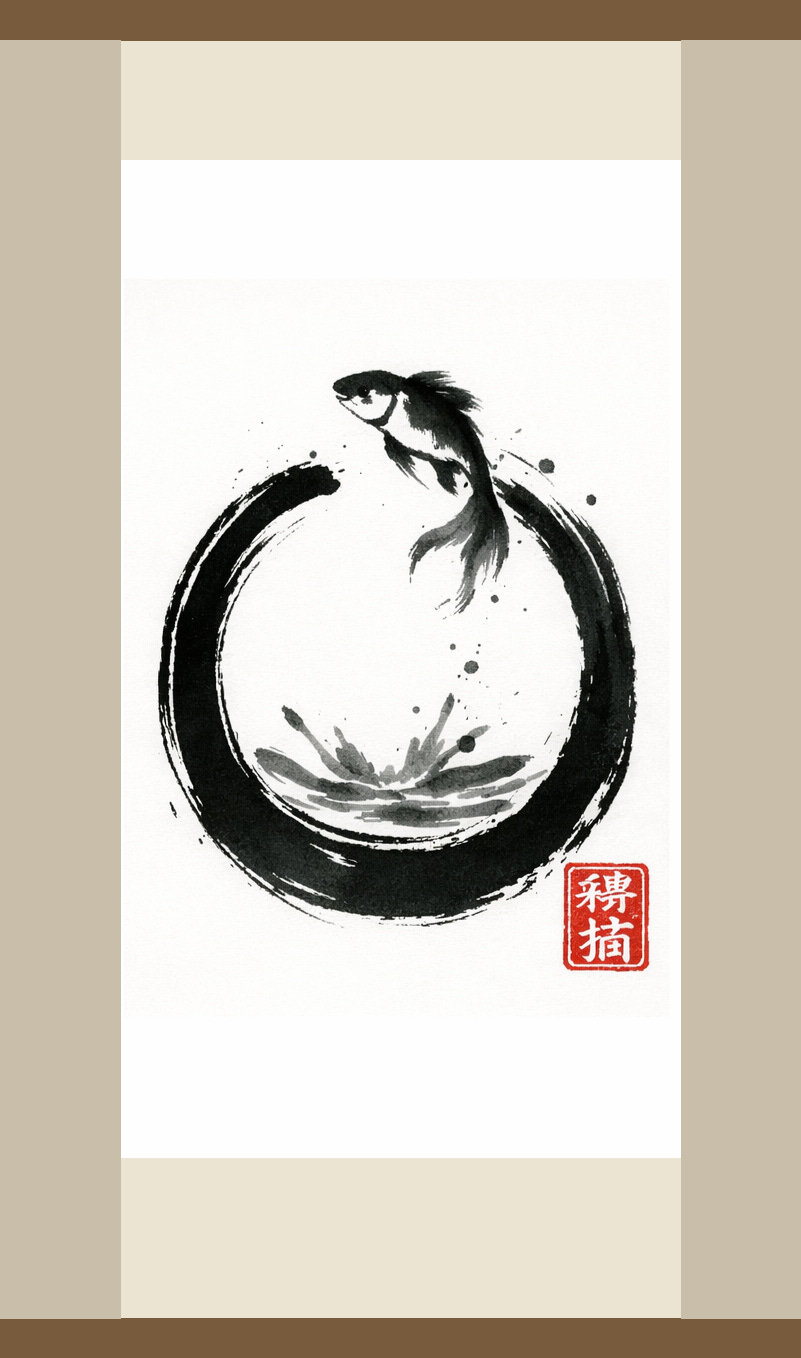
Just like a fish cannot survive exposure to the air, the mind cannot survive exposure to reality. It thrives in the narrative medium and so rather than force it to live in a state of suffocation through exposure, one creates a fishbowl - an intentional narrative container in which it can live while contained within the greater vastness of beingness which remains visible at all times through the container’s transparent boundary.
And so this dull, gray, pointless and apathetic phase you find yourself in the midst of is your mind’s interpretation of a clarity it has no means of processing. And so it defaults to a narrative of depletion - and the nervous system follows suit. Yet, it is really an opportunity - a liminal space of possibility rather than a purgatory.
The walls are open, the plumbing and wiring exposed. The mind may interpret this as ‘crumbling or falling apart’ - but it can equally be trained to view it as a renovation.
An opportunity to reimagine the self.
To actualize it not according to some default design you inherited.
But as something aesthetically appealing to your unique sensibilities.
I hear echoes of the Gita: you train the mind first so when satori comes you have a structure that supports it after. So good to have words that contextualize experience. Much of the most meaningful transformation is preverbal.
The emptiness that's never empty, only rarefied until the senses adjust.
Reducing or eliminating caffeine helped me.
And yet, any discomfort/adrenaline-withdrawal still arose against the backdrop of peace that passeth understanding. That's trippy in itself!
Being-ness, peace, is always there - whether in the foreground or the background, awaiting some breath & stillness for it to dial back up (for US to dial back IN). REST is truly an acquired habit in this day and age❤️🙏🏼☮️