
Doppelganger
Your most authentic self isn't real.

“Shiv— thanks for your essays. They give me a lot to ponder on, often many days after reading them. I’ve spent most of my life trying to become a more authentic version of myself. But lately, especially after reading your essays, I’m starting to wonder what that even means. Does authenticity relate in any way to awakening?”
.
***
.
In 2012, an unassuming spider no more than a few millimeters in size, belonging to the genus cyclosa, was discovered in the Amazon jungles of Peru and found to display a remarkable talent. This spider (so rarely encountered that it has yet to be named) has a knack for building decoys of itself. This behaviour is not so unusual in itself. It has been observed in other spiders of the genus. But what makes this particular spider’s art so fascinating is the level of detail and precise nature of its decoys. In fact, the only difference between the spider and its decoy is that the decoy is several times larger than the spider and more menacing in appearance.
The spider uses natural materials - prey carcasses, plant fragments, and silk - to construct a larger-than-life replica that mirrors the spider’s own anatomy. It places the decoy somewhere on its web and even shakes the web from time to time - making it seem like the decoy is alive and moving. This acts as an effective evasion strategy that protects the tiny spider from natural predators who might think twice about attacking a spider the size of the decoy. Some female spiders have also been observed to hide their eggs in the decoys.
“If the threat gets too close for too long, the spider will vanish, turning their web into a theatre of deception,” says George Olah, one of the lead authors of the new study in the journal Ecology and Evolution.
A spider, no larger than a shirt button, capable of deceiving predators several times its size, with a simple illusion. Unlike most other spiders that build hideaways or retreat into inaccessible spaces to protect themselves - this one hides in plain sight merely pretending to be something it is not. And yet, what makes its illusion so convincing is the authenticity of its doppelganger. Unlike other decoy-building spiders that build clumps of debris and silk that may somewhat resemble a spider from a distance - this spider’s artwork is remarkably lifelike even up close.
If the brain of a tiny spider can pull off such a feat, imagine what a human brain can do.
The ego - the persona we present to the world (and often even to ourselves) - is that doppelganger that we use for many purposes. Unlike the spider whose primary goal is protection - our own social survival is far more complex. The persona acts as that invulnerable exterior that masks our vulnerabilities - but it also functions as that appealing front that earns our invitation into social dynamics - work, friendships, intimate relationships, societal interactions.
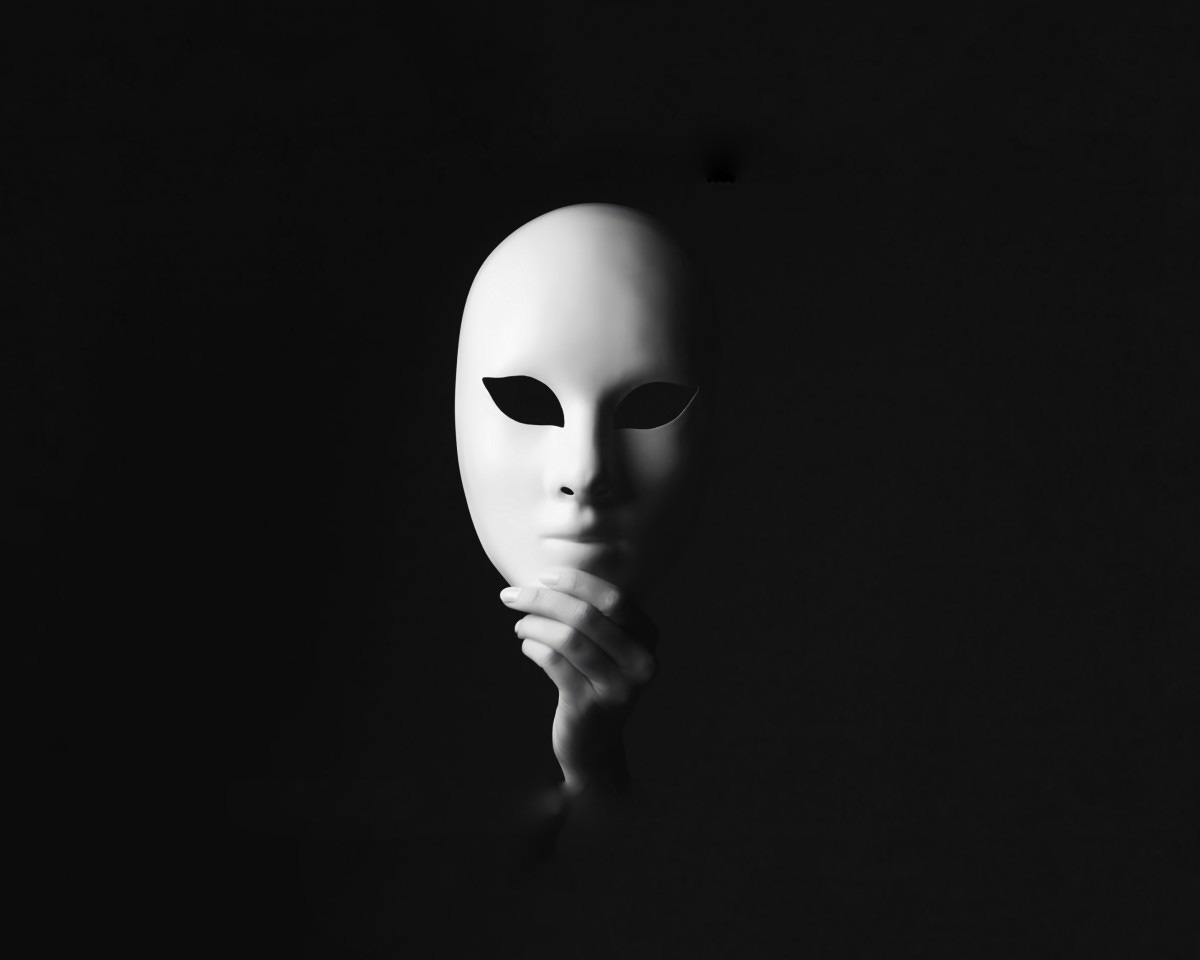
It is never ‘you’ who interacts with the world. It is always your doppelganger. And we rarely wear just one mask. Depending on the social environment and who we are interacting with, we may don a different mask. In the presence of a work colleague, your face, your voice and your body may behave quite differently than they do when you are interacting with family members. A familiar friend may encounter a slightly different version of you than a random stranger will.
In fact, we tend to think of the question of ‘authenticity’ in terms of consistency between these masks. For example, if you were to see me behaving in one way with my friends and in a completely opposite way with strangers - you might think me ‘inauthentic’. Whereas, if the version of Shiv you saw changed very little regardless of whom I was interacting with - whether family, friend, colleague, or stranger - you may decide that I am quite an authentic fellow.
Framing authenticity as a ‘consistency of personality’ is an easy misunderstanding and an error that I myself made for many years. Growing up in big cities, many of the personalities I encountered were quite fluid and changeable - people seemed to modify who they were and how they behaved in accordance with the social scenarios they were in. But moving to the country, I began to notice quite the opposite. Country folk seemed more honest, salt-of-the-earth types. They didn’t talk quite as much, and rarely seemed to modify how they spoke or presented themselves. I took this to mean that people in the country were ‘more authentic’ than city folk (as a general phenomenon, although there are exceptions on both sides of that argument).
Yet, as I came to know many of these individuals more personally, I realized that they suffered in much the same way people in the city did. Whether a person wore ten masks or just one, the dynamics of misunderstanding and suffering were the same. Socially diverse environments appeared to require diverse and adaptable personas. Socially consistent environments appeared to foster consistent and steady personas.
Authenticity, I came to realize, was not a function of choice but of environment.
One spider may build a single true-to-life replica of itself. Another, more creative, spider may build ten wildly different decoys - one menacing one for protection, one sexy-looking one to attract a mate, one buff-looking one to scare off other spiders, one dead-looking one to attract insects and so on. Regardless of whether a spider builds one doppelganger or ten, none of the doppelgangers are authentic.
An authentic-looking replica is no more real than an inauthentic-looking one.
The same goes for the persona.
A down-to-earth, consistent, and humble persona is no more authentic than a bombastic, superficial, and fickle persona. One may appear more grounded and the other caricaturish - but how a persona presents itself reveals more about what the person is feeling and how they have learned to cope, than who the person is.
There are a couple of reasons why a person may be drawn to becoming ‘a more authentic version’ of themselves.
The first is a management issue. Recall the spider who has built ten different doppelgangers of itself. The continual building and maintaining of these multiple doppelgangers requires a lot of energy and upkeep. Similarly, maintaining and managing multiple social masks is psychologically draining for a human being and it is only worthwhile within a social structure that is highly stratified and there are clear boundaries and divisions of expectations between the various arenas they function in.
In Japan (where I lived for nearly a decade), for example, individuals typically maintain multiple personas - a work persona, a socializing persona, a home persona, a general persona for interactions with strangers - because these aspects of social life are very clearly separated from one another by strict social boundaries. Japanese people rarely ever mix friend groups. Spouses rarely hang out with each other’s friends. Work acquaintances and personal friends seldom mix. This is specifically set up so that an individual doesn’t have to deal with the conflict of having to wear two very different masks at the same time.
This clear demarcation of social arenas of engagement was once the case in the West as well. However, these days, those boundaries have blurred. As social expectations relax and demeanors grow more casual (where suits-and-ties were once the norm in the workplace - now most people dress for work like they dress at home) our personas have also begun to blend together. The result is that we need fewer different masks - most of us are better off developing one good mask that can be slightly modified for the occasion.
And this is the second reason why we may be drawn to authenticity. There is a social imperative to do so.
It is why ‘authenticity’ has become such a buzzword in western cultures but not in the East. It is not that we in the West are more genuine and honest than our Asian counterparts - it is that our social expectations are different. Our definitions of what it means to participate in society have changed. Our requirements for what it means to show up are more fluid.
People who live in socially-stratified cultures, such as Japan, display higher degrees of social awareness than their Western counterparts. They are less interested in constructing a doppelganger that ‘feels true to who they are’ and more driven to developing a series of efficient masks that match the exact demands of their layered social environment.
People who live in more socially nebulous cultures, like that of our own, display higher degrees of self-awareness but lower social awareness. We are more preoccupied by creating a single lifelike replica of ourselves - one that exhibits creativity over function.
And so, the ‘authentic self’ is an evolutionary outcome of a changing social landscape. It is common knowledge that individuals in Gen Z are reported to be more acutely self-aware and also more socially awkward than previous generations. Authenticity is not something we choose - it is merely a response to shifting social pressures.
Whether you wear one mask or ten, whether your persona is polished or rough-around-the-edges, whether the doppelganger is compliant or unconventional - says very little about who or what you truly are.
This brings me to your question of how authenticity relates to awakening.
