
Supermind
Enlightenment is no longer a spiritual ambition. It is a survival imperative.

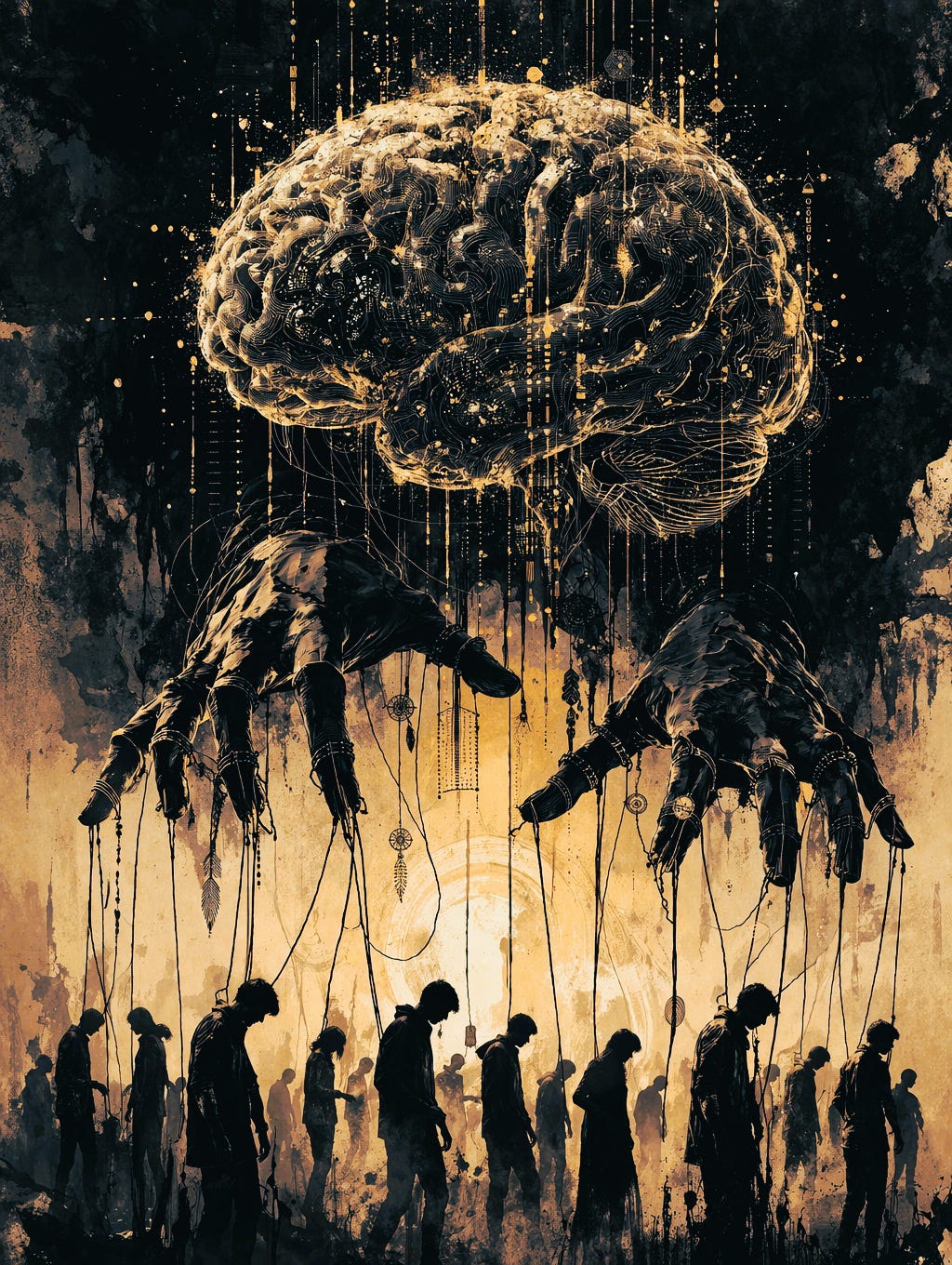
We live in a time when the circumstances around us are driving us to develop a single capacity that has, until now, been woefully lacking in humanity. This capacity has long been the focus of philosophers and mystics alike - but it can no longer remain an esoteric interest. It has become a survival imperative. The ability to develop this single capacity will make the difference between whether we are able to navigate what is yet to come, or succumb to it. I am not speaking of presence, patience, peace or compassion. I am speaking of discernment.
It is the capacity to tell signal from noise, true from false, essential from trivial. We are no longer inhabitants of the information age. We have now entered what I like to call the autonomous information age. A world where information is no longer created by human beings but by information itself. It is a world in which the balance has suddenly shifted. Historically the producers of information - the writers, the newspapers, publishers, magazines - were always outnumbered by the consumers of that information - the readers. This made information a valuable commodity - precisely because the demand for it was so high and the supply so limited. Today that balance has flipped with the advent of AI. Today, a single consumer has unlimited and unfettered access to information at virtually no cost. As a result, our own attitudes towards information have shifted. Rather than a privilege, we see it as a given. It simply appears to us when we want it - much like water flows through our faucets by turning a knob.
Yet unlike our water supply, it is not being generated, regulated or quality checked by governing bodies. We do not know how clean the information we are receiving is. What kinds of pollutants are we consuming? We would hesitate to drink water from an untrusted source, yet we consume information without question. Today, AI-generated content - whether text or video - comprises a significant portion of the information we are exposed to. News broadcasting companies have long been using AI to generate written content and now some channels are even using AI-generated broadcasters to read the news. If both the content and the communicator are generated by LLMs - then, at a certain point, regulating that content becomes a near impossibility.
No longer does the old adage “seeing is believing” apply anymore. Just think about the implications of this. The human brain and biology has evolved to use the senses to verify reality. Our senses are the most reliable instruments we have. Even before the mind weaves its narratives, our senses inform us of certain inalienable facts. It informs us of a baseline reality we can all agree upon.
For example, a devout Catholic may see the face of Jesus in the piece of toast whereas an atheist will see only a blackened shape on it. And the two may argue about whether there really is a Jesus in that toast or simply a burnt section. Their disagreement is only at the level of reason - where the Catholic’s mind attributes divine symbolism to mundane events and the atheist’s mind uses only strict rationalism. Yet, the one fact that both unequivocally agree upon is that there is a toast. The toast here is the baseline reality - and the presence or absence of Jesus is the interpretive layer.
But what happens when that baseline itself can no longer be trusted? When the existence of the toast itself is in doubt?
The era that we are rapidly transitioning into is one in which it is not what is happening that we will be arguing about but whether what is happening is actually happening. When our basic litmus test for reality - seeing itself - fails. When we are not merely questioning our own thoughts and beliefs, but our very perceptions themselves.
Am I seeing things that are not really there? Am I hearing voices that are not really there? Am I talking to people that are not really there?
This is what psychosis looks like. And it is descending upon us collectively.
The gut reaction, of course, is to double-down. Seek out those sources of information that are trusted and reliable. Stick to platforms that have higher standards of curation. Avoid AI-use except for expediting mundane or practical tasks. Stay informed on world news from multiple and diverse sources rather than one’s pet media network. While effective in the short-run, these are only stopgap solutions. It is only a matter of time before the entire attention economy is comprehensively captured in such a thorough manner - that there will be almost no means of distinction between ‘trusted’ and ‘untrusted’ sources. We will no longer be able to distinguish between human intelligence and artificial intelligence. And the reality we live in will be crafted by agendas that no human being can detect.
There are those who, sensing the impending chaos, are choosing to retreat into relative isolation. These are the cyber ascetics - renunciates of a different kind - who, seeing the chaos and madness around them, choose simply to disengage from it and retreat to a simple life. Yet this is not a tenable solution either, as the digital world continues to become exceedingly pervasive and infiltrates every aspect of our interactions, communications and behaviour. Soon these few avenues of escape - the rural communities, the blue collar jobs, the nomadic ‘vanlife’ - will also be entirely captured.
We are at the cusp of a reality overhaul - one that will make the industrial revolution look like an unremarkable event. There is little we can ‘do’ to buttress against it - no strategic plan, no lifestyle change, no underground subculture, no intentional community, will protect against the absolute and total attention capture that is inevitable.
We are going to be in the thick of it. There is no question about that. The only question that then remains is: how does one navigate that reality? How does one operate in a reality that the senses themselves cannot clearly distinguish?
The answer is discernment. And not merely intellectual discernment in the form of critical thinking - although that will certainly be a necessary skill as well. I am talking about a much more fundamental kind of discernment. One that is deeply intuitive and uniquely equipped to navigate an artificially constructed reality.
Fortunately, we have already had exposure to exactly such an environment long before the advent of AI, the internet or even machines. We each have access to our own private laboratories in which exactly these sorts of scenarios can be observed, experimented with, and tested.
And it is there that our revolution must begin.
