
The Inevitable Stain
Your shadow is not what you think it is.

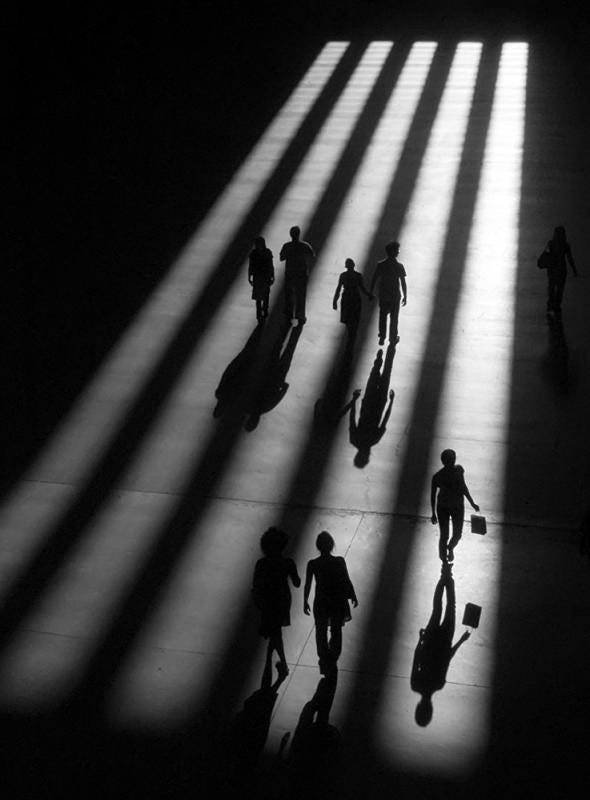
“I’ve spent years on the spiritual path trying to accept life as it is. Intellectually, I understand that reality includes both beauty and suffering, creation and destruction. But actually living that truth feels like something else entirely.
Every day I am confronted by the shadow of this world—war, cruelty, illness, loss, corruption, and the endless ways people hurt one another. Part of me wants to remain open to it all without turning away. Another part wants to protect itself by becoming indifferent, cynical, or simply looking elsewhere.
How do I remain fully in this world without becoming overwhelmed by it? More importantly, how do I truly accept the shadow of reality without either resisting it or becoming numb to it?”
.
***
.
The shadow is woven into the fabric of reality. It is as much an aspect of reality’s nature as is the light.
As I write this, the trees outside my window are bathed in sunlight. Yet, what makes the scene seem so ethereal are the numerous shadows and contrasts interspersing the light - each leaf casts a shadow on another leaf and, in turn, has a shadow cast upon it. The resulting effect is a filtering of a pale-green diffuse kind of light that illuminates the backyard with a vivid sharpness. I can see the grain in the wood of my deck, I can see the nooks and crevices in the gravel stones, I can see each blade of grass highlighted as if it were the only blade that ever mattered.
Pure sunlight could not reveal this degree of detail. It is why photographers so profoundly cherish those partially overcast conditions in which the sun breaks through darkening clouds casting the whole landscape in a similar diffuse light. The degree of detail and clarity such photographs possess are difficult to replicate simply by adjusting the settings of a camera, no matter how adept a photographer may be.
The world casts its shadow upon you. And you cast your shadow upon the world. They are one and the same shadow.
What is the Shadow?
Before one wonders how to accept or integrate the shadow, one must first begin with an understanding of what this shadow even is.
To exist in one way means to simultaneously not exist in infinitely many other ways.
The moment existence takes form, every other possibility is excluded. Shadow is the realm of what is excluded.
The old adage: “You can’t have your cake and eat it too” speaks to this very shadow nature. The having and the eating both co-exist as possibilities. But only one can be reality. You can only have the cake as long as you do not eat it. And once you eat it, you cannot have it.
When one becomes reality, the other becomes its shadow.
In other words, the shadow is not inherently ‘wrong’, ‘bad’, or ‘evil’. It is merely unrealized potential.
It is the result of a trade-off that is made in order for reality to even exist. The sacrificing of every other possibility for one actuality.
This is evident even, and especially, at the quantum level in which a photon exists as a wave function - a field of potential positions - yet collapses into a particle with a very specific position the moment it is observed. In that moment, every other position in that wave function becomes an unrealized possibility - its ‘shadow’.
Your shadow is your unrealized potential - all the latent aspects within you that exist as possibilities but do not manifest as actuality. Some of that potential may be positive, but some of it may be negative. For example, you have the potential for great wisdom, compassion, quietude, peace, and kindness. But you also have the potential for ignorance, tyranny, oppression, aggression and cruelty. The shadow comprises all that remains unexpressed as latent potential within you - the good and the bad.
The shadow isn’t a problem. It is our denial and willful ignorance of it that can become problematic. And this is where religious forms of morality can exacerbate the situation. We have all heard of nuns who ruthlessly disciplined and tortured indigenous children while professing the compassion of the Christ in the same breath. We have heard endless stories of priests who molested their choir boys while providing the sacrament on the very same day.
When the shadow within us is denied, it becomes projected upon the world in the most distorted ways. Children of another race become ‘savages’. Young boys become the objects of lustful fantasies. An entire ethnic community of Jews are seen as ‘rats’ and ‘vermin’. Any progressive citizen of the world becomes an ‘infidel’.
The intensity and quality of our reactions to the greed, the depravity, the intolerance, the hatred we perceive in the world relates to how we see ourselves - or rather, refuse to see ourselves. For the greed of the corporate tycoon lurks within our own souls too. It exists as unrealized potential - as our shadow. But if we react to the tycoon’s greed with disgust, it suggests that we have denied or ignored that aspect within ourselves. Or if we see it, we feel that same disgust for that potential within ourselves. Similarly, when we grow angry with the exploitative and hypocritical nature of others, there is something of that nature that exists within us as well. And the degree to which we deny that nature within us is proportional to the degree with which we refuse to accept it in others.
That is not to say one must live without any form of morality or code of conduct whatsoever. Only that our own reaction to the shadow of the world acts as a path of discovery of our own shadow.
And here is the wider lens.
You are but a single particle in the wave function of consciousness. It so happens that the observing awareness within you has collapsed into this particular configuration of a self - a mostly ordinary position with certain redeeming qualities, a few flaws, but a generally benevolent disposition. But that wave function contains every other possibility as well. And in someone else that observing awareness has collapsed into a great and benevolent leader. And in someone else, one of the most vicious tyrants of our times. Every permutation and combination is possible and can come to fruition. And when it does, every other possibility will exist as its shadow.
The tyrant is your shadow, as is the saint.
And you are their shadow too.
Accepting the Shadow
Imagine you are standing and facing the sun. Your experience is one of warm benevolent sunlight. Yet, you are simultaneously casting a shadow behind you. And any creature or organism that happens to be in the path of the shadow you cast is, in that moment, being deprived of the warmth of that very sun.
Now imagine you were to turn around, so that your back is to the sun. You will now be gazing on the darkness that your own shadow creates. You will see how the flowers that stand in your darkness begin to droop when compared to the ones around them that appear to stand tall.
This may disconcert you because you do not want to be the cause for other organisms to be harmed, or to be deprived of the chance to thrive. And so, with your back to the sun, you begin to move - attempting to rid yourself of this shadow. Except you find that no matter where you go, no matter how far you travel - whether you scale lofty mountains or trek across wide plains - that shadow faithfully follows. It does not leave your side.
And wherever you go, the same dynamic follows - the shadows you cast deprive other beings of the light. You come to the realization that this is an unchangeable dynamic.
Most people are so terrified of arriving at this realization that they spend most of their lives simply facing the sun. They deny their own shadows refusing to believe that they are capable of generating suffering and instead focus their attention on the shadows other beings are casting upon them.
The shadows of other people, the shadows of society, the shadows of institutions, the shadows of government. The larger the system or structure - the vaster its shadow. And even when these systems are benevolent and primarily oriented towards the light, they have no choice but to cast shadows.
Thus the great dichotomy, that even our heroes, our great leaders, our most progressive voices - will inadvertently cast darkness onto the lives of some. There will be people, entire communities, ways of life - that feel forgotten, left behind, disenfranchised, and gradually wilt into cynicism, anger and extremism in their wake.
And so history repeats itself. Benevolent light-facing structures built upon noble ideals cast shadows from which more tyrannical, regressive, and dark structures emerge. And it is from the suffering of these shadows that newer, more progressive and benevolent structures emerge.
Gandhi liberated 300 million Indians from British colonial rule and yet his own policies led to the partition of the country during which nearly 2 million people lost their lives due to the violence associated with the displacement. Mother Teresa provided decades of care to the forgotten street people of India, many of whom had leprosy and were shunned from society. And yet, her opposition towards abortion and even contraception created much suffering for many of the women in her care or her influence.
Even saints must cast shadows.
Unrealized potential, when not consciously acknowledged and even held with reverence, turns into bitterness, envy, cynicism, and even hatred when we perceive others who do manifest that same potential. And this may even relate to so called ‘negative behaviours’.
I once had a friend who stopped talking to me for years with little warning. Later on, we reconciled and he confessed that one of the reasons he had to break off our association was that he felt bitter and resentful of me for my ability to simply say what was on my mind - even if that thing was uncomfortable. He had been raised to suppress such direct forms of communication and so any frustration on his part would show up in distorted forms of passive aggression or subtly punitive behaviours - like declining a dinner invite on account of ‘being tired’, or dropping out of a trip we had planned together at the last minute for dubious reasons. His own aggression lay as unrealized potential and so any perceived aggression on my part stoked envy, cynicism and resentment within him. It was only later - during the hiatus - that he came to see how much of that bitterness was self-directed as a result of his unwillingness to acknowledge his own shadow.
Accepting the shadow first begins with oneself. A person who is drawn to face the sun for fear of darkness gradually turns around and notices the shadow she casts. At first she believes that if she simply notices and accepts it, it may eventually dissolve. But she soon comes to realize this is not the case. Her existence is the very nature of what-is. And being what-is, it cannot be everything else it could be. If she is a single mother - then the time she spends at work as the sole bread-winner will cast a shadow over her potential to be emotionally available to her children. If she is a stay-at-home mom raising her family with love and nurture - she casts a shadow on the potential she has to be a powerful and competitive business leader. Gandhi, to use his example again, was the ‘Father of a nation’ but was woefully absent as a father in the lives of his own children.
Most of what we are will remain in the shadow. This is probably the most difficult aspect of acceptance. Here the old US Army slogan of “be all that you can be” could not be more flawed. For whatever you become, you exclude an uncountable number of other options of whatever else you could have been.
Integrating your shadow is not about ‘realizing your full potential’ but about making peace with your unrealized potential. Not a blind and ignorant peace. But a deeply conscious and introspected one.
For every moment that you exist, there is someone in the world being a version of you that you are not. If you despise them or fear them - then you despise and fear that unrealized aspect within yourself. Yet, if you acknowledge their existence while also understanding why you cannot manifest in that way - whether that be due to practical constraints or an ethical choice - then you validate their existence. You understand - on a spiritual level - why their existence matters.
This does not mean you cannot oppose their behaviour if that behaviour clashes with your ethics. Acceptance does not mean condoning. It simply reiterates why you have chosen to leave that potential unrealized within you. It is not that you are incapable of greed, exploitation, and oppression - it is that you have chosen not to express them in favor of other expressions. Yet, you realize that those potentials cannot be eradicated. If not through you, then they will express through another. And just as another’s greed lies as latent and unrealized within you, your generosity lies as latent and unrealized within them. You are their shadow and they are yours.
When you accept your own shadow - you accept all in the world that your shadow manifests as.
.
After a while of facing her own shadow, and seeing how no matter where she goes, no matter how often she orients to towards the light, things will wilt in the darkness she casts behind her - she begins to develop a different perspective. She realizes that this dynamic is not inherently wrong - it is inevitable. She comes to see that although her shadow does create a certain degree of suffering, it also provides certain benefits. For instance, it provides temporary shade to those flowers that may suffer from overexposure to the sunlight.
More importantly, she realizes that her shadow is not the problem. The problem results when she stands still. When she becomes so rigid and fixed in her way of being that her shadow becomes just as fixed. Then everything that lives in her shadow eventually suffers and dies from the prolonged darkness.
Yet, when she becomes fluid, flexible, moving freely from here to there - her shadow moves and transforms with her. It glides over rocks and streams, over grasses and hills - morphing, shapeshifting along the way. While her shadow is constant it does not linger anywhere for long - and in not lingering, none suffer from prolonged exposure.
Those who are rigid, set, and inflexible in their views - no matter how noble and progressive those views might be - cast fixed and unchanging shadows that then cause grave suffering, even if unintentionally. Yet, when one is flexible, adaptable, willing to inhabit myriad perspectives or points-of-view without necessarily adopting any of them as one’s own - then one is perpetually shapeshifting with the circumstance. And in doing so, their shadow also shapeshifts. And so, one becomes the cause of a million tiny independent grievances but not the architect of a single great suffering.
The trees in my backyard are perpetually swaying. Their leaves dancing and shivering in the breeze - the light that filters through is never static. The shadows on the ground are perpetually shifting - as is the light. And all sorts of flowers and shrubs thrive beneath and around them. They receive adequate light and shade precisely because no section of the ground sits in permanent darkness.
In another part of the backyard sits an old shed. I store my gardening tools, old tires and a deep freezer in it. There is a section behind this shed that never gets any sun. It is dark, damp and no plants ever grow there. But if you dig into the soil, you find all sorts of insects - worms, beetles, cockroaches, the larvae of flies and moths.
As unpleasant as they are to look at - they are doing something vital for the backyard. They are consuming detritus and enriching the soil. It is in that very soil that those same trees, that provide shade to the same beautiful flowers, stand.
And this is perhaps one of the deepest realizations of the nature of the shadow. Even those structures, systems and people that appear rigid, unyielding, and oppressive and cast shadows so dark and unmoving that they prevent any kind of growth - inadvertently become the destructive agents that prepare the ingredients of some future flourishing.
Nothing is ever wasted. Energy is never destroyed.
From atrocity emerges redemption. Every golden age contains the seed of its own decline.
The shadow is not the antithesis of the light.
It is its soulmate.
Its faithful companion.
Its unrecognized twin.
And if the shadow could speak to the light, it would say:
“I bear the burden of holding space for everything you cannot be.”
Perhaps the shadow of the seriousness of this well-written article falls on me, compelling me to reply with a Steven Wright joke... "I have an extremely large seashell collection. I keep it scattered on the beaches of the world. Maybe you've seen it."
“And as we wind on down the road
Our shadows taller than our soul…”
—Led Zeppelin