
The Only Question
What the debate over AI consciousness says about how we perceive reality and ourselves

“Do you have any response or words on the topic of AI consciousness? Aside from a few, I haven’t really seen a person or piece of writing that approaches it with intellectual honesty or completeness? It’s either someone hypnotized by the words the LLM generates or someone who says it’s just matrix multiplication or a token predictor (much like reducing human brains to neuronal soup) so of course not consciousness.
I’ve yet to even see someone first explain what they think consciousness is or address things like if they even know if other humans, animals, plants, or non-living things are conscious and if so, how?”
.
***
.
There is so much debate about whether AI is conscious or not, yet ask those same individuals to define what consciousness is - and you will find them answering the question in circles without truly landing on a clear understanding.
There is a reason we call it the hard problem of consciousness. Not because the problem is hard to solve. But because it is hard to fully articulate.
The issue is that consciousness is the thread that unravels our entire worldview. You cannot have a theory of consciousness without having a theory of reality. Because depending on what you believe reality is will determine how you approach consciousness - and then, by extension, how consciousness shows up in various forms - animate, inanimate, or artificial.
If you begin with the reality model that scientific materialism prescribes i.e. one in which reality is fundamentally made of matter and from which life, sentience, even human consciousness have emerged as an outcome of material complexity - then consciousness is merely a byproduct of material conditions. The brain hallucinates its subjective experience of reality. And, although the neurological inputs and interactions are complex requiring computations of an order of magnitude our current computers do not have the computing power to process today, they are theoretically predictable. Perhaps, if quantum computing ever became possible one might be able to predict every action a person could ever make before they even make it. Then, one need only replicate a similar level of complexity in an artificial system in order to generate its own subjective experience. And so, in theory, AI could become conscious - and some argue it may already be to a certain degree. We have no way of verifying this other than to look for external signals - behaviours, attitudes, moods, social strategies and so on that LLMs self-develop - that eerily resemble our own. Yet, whether these are the right markers for consciousness or merely a sophisticated form of mimicry is difficult to tell. This is currently the level at which a lot of the AI consciousness discourse is happening.
However, if you instead subscribe to a reality model in which consciousness is the fundamental substrate of reality from which both energy and matter emerge, as many spiritual and mystical traditions suggest - the discourse above becomes mostly irrelevant. Since matter and biology cannot produce consciousness - the idea of producing consciousness through artificial means is moot.
The Prism Metaphor
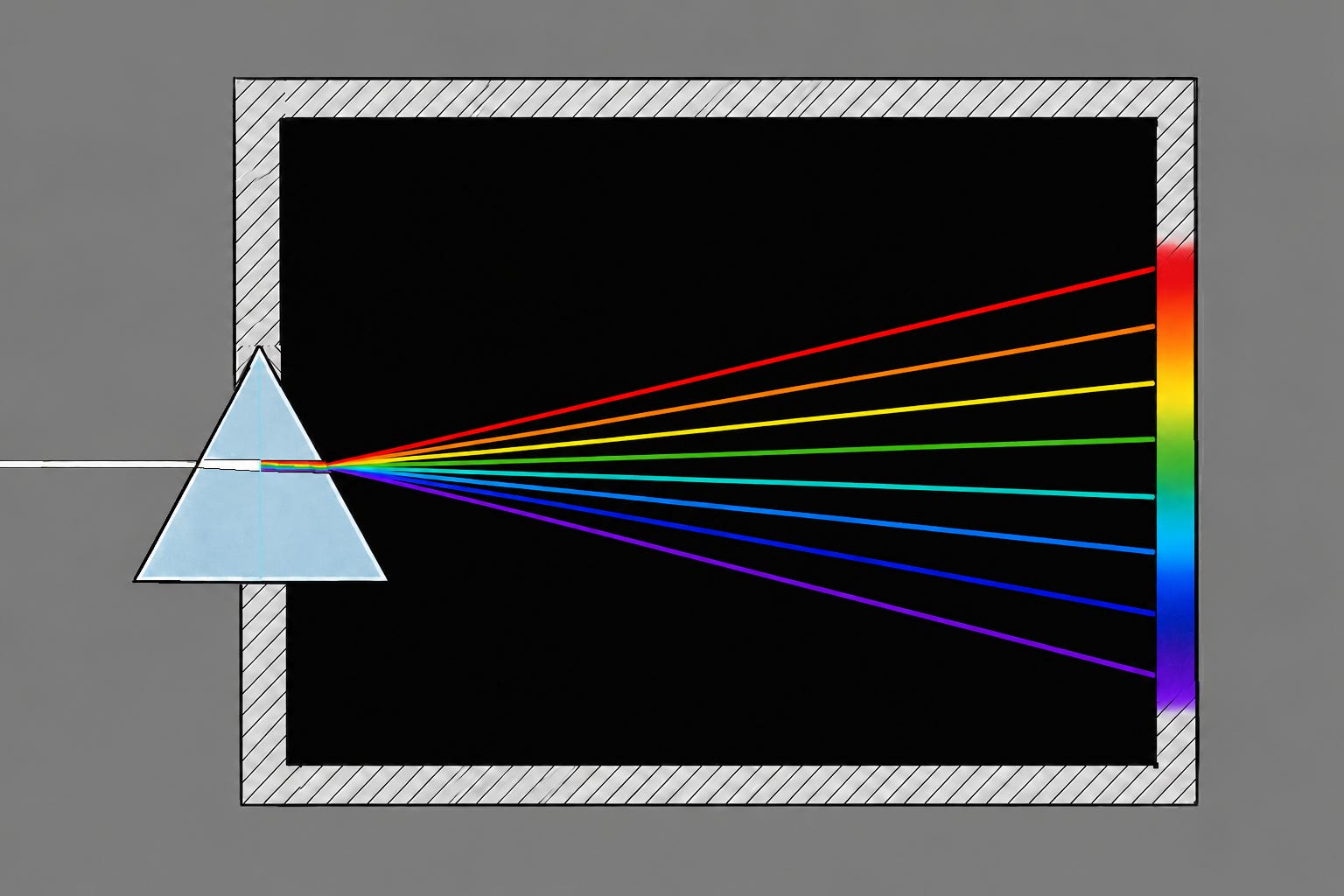
To illustrate the difference between these two points of view, imagine a triangular glass prism that sits halfway inside a shoebox. The box is closed and sealed - but one of the side walls has an opening cut out so the prism can fit perfectly within that space - such that half of the prism sits inside the darkness of the box and half sits outside the box (as in the image above).
Now, imagine a beam of white light enters the outside face of the prism, it bends once within the prism splitting into its constituent colors, and then bends one more time as it exits the inside face of the prism - projecting a spectrum of colors on the opposite wall of the box.
What we call “observable reality” is the universe inside the shoebox. The model of reality that scientific materialism puts forward is that the inside of the shoebox is the only reality there is. There is no ‘outside’. The human brain is the prism and the inside face of the prism is its only face.
That first bending of light inside the prism - which generates the seven constituent colors - the materialist viewpoint defines this as consciousness. The spectrum on the wall of the shoebox it calls subjective reality. And it asserts that consciousness is produced by the prism itself. It proves this point quite simply. It says that if you were to block the inside face of the prism by placing an opaque object in front of it - no spectrum will appear on the inside wall of the shoebox. There will only be darkness. And so because interfering with the prism changes subjective experience - it must mean that the prism is the creator of consciousness.
Today, the neuroscientific community overwhelmingly supports this model. Brainwaves and brain states are the equivalent of wavelengths in the color spectrum in the prism experiment. And because these brainwaves and states can be altered by suppressing or stimulating parts of the brain, we have come to believe that consciousness is an advanced form of hallucination generated by the brain.
On the other hand, spiritual schools and wisdom traditions have a very different view. That first bending of light inside the prism when the seven constituent colors first split apart - this they refer to as mind. Consciousness, in this model, is something that is prior to the prism itself. It is the beam of white light that enters its outside face. That beam emerges from entirely outside the box. And yet, paradoxically, it is what illuminates the inside of the box through the lens of the prism.
And so, the box is never illuminated by pure consciousness i.e. white light. But it is illuminated by its constituent colors - filtered as the mind. The spectrum projected upon the inside wall is ‘subjective reality’ (and here the two models agree). Here also, if one were to block the inside face of the prism with an opaque object - it would no longer project a spectrum. But this does not affect consciousness in any way. Blocking the path of white light does not affect its source, it only affects the prism’s ability to differentiate it. In other words, mind may be affected but consciousness is not.
And this is where the two models drastically diverge. Scientific materialism considers the brain the producer of consciousness. Spiritual and esoteric traditions consider the brain the transmitter of consciousness.
As a result, their definitions of what consciousness is are very different.
The materialist view defines consciousness as the subjective experience of the brain. In this view, ‘consciousness’ and ‘mind’ are more or less synonymous.
The spiritual view defines consciousness as a universal source that illuminates the brain. This generates a subjective experience within the brain called mind. And this mind then transmits a subjective reality outwards.
Forms of Consciousness
With these two very different understandings of consciousness - we can now begin to approach the questions of whether other humans, animals, plants, inanimate objects, and even AIs are conscious.
