
The Self Experiment
The architecture of conflict and the dichotomy at the root of our experience

The announcement on the PA system rang clear. I was being summoned to the school auditorium urgently. I stifled my grin, unable to believe my good fortune. Whatever this was about, it had to beat the numb despair the droning voice of my 8th grade chemistry teacher induced in me. I feigned disappointment and asked him if I could be excused, then ran down the four flights of stairs - skipping three at a time - towards the auditorium. I burst through the doors to find a group of 24 boys, of various ages, on stage rehearsing a play.
The play director, our arts and music teacher, was a flamboyant yet tyrannical man. He approached me looking flustered and said, “Shiv, you are going to be the Recorder. Our lead actor has broken his leg and can’t play the part anymore. Start studying his lines! We have less than two weeks!!”
The play in question was “Us and Them” by British playwright David Campton. Our school was to perform the drama as part of a city-wide interschool dramatics competition. Known for our theatre program - we were widely considered top contenders, but had stiff competition in some of the private schools in the city. Rehearsals had begun six months earlier during the summer break - and I had initially been cast in one of the minor parts. However, an overseas vacation with my family later that summer meant I would miss many of the rehearsals - and so I had been cut from the play.
Now, nearly six months later, the student playing the main role of the “Recorder”, a 12th grader who also happened to be the student council leader and school valedictorian, had broken his leg. And the director thought I should replace him, since I was the only student in the school, not part of the cast, who was familiar with the script. The problem was - the Recorder’s lines were the longest and most significant. And with less than two weeks remaining - the task seemed a near impossibility - especially since the rest of the cast had been rehearsing for several months.
The play Us and Them is a story about two groups of people who wander into a new land that is pristine and untouched. They are surprised to see one another at first and agree to share the land. They decide to divide the land with a line which eventually turns into a fence - and then into a wall. What began as a feeling of camaraderie gradually gives way to suspicion. Unable to see what the other group is up to, each group’s mind wanders imagining the heinous attacks the other is planning. Finally, both groups attack the wall bringing it down. They then go to war destroying one another. In the end the few survivors on both sides blame the wall for what happened.
What is unique about this play is the rapid fire manner in which lines are delivered. All the characters mostly speak in one line statements. And with several characters on stage - timing and delivery is everything. Each actor has to know their cue. If one person forgets, the momentum of the play dies. This is why rehearsals had to begin six months prior. It was not learning the lines that was the challenge - it was the choreography of position, delivery, timing and action that had to be fine-tuned to perfection.
The Recorder’s role in this play however is a unique one. His is the only part that has lengthy monologues. He is not so much a participant in the drama as he is a perennial witness to these cycles of history. His commentary is crucial - because he sees everything that unfolds as inevitable. It is the same pattern every time. Unavoidable as long as human nature remains fundamentally unchanged. The Recorder’s own character is equal parts humorous, cynical, tender, and poignant. It is clear that he cares deeply for humanity and yet he knows that these historical cycles of unfolding suffering cannot be avoided until humanity itself becomes self-aware.
One of his last lines in the play goes:
“It’s all down here. Over and over again. History. The record is kept because someday someone may learn from it. Now I’m required elsewhere. Oh, this all becomes so monotonous. (He starts to walk away, but pauses). Someday. Someone. Somewhere. Is it possible? Hah!”
Over the two weeks we rehearsed, I considered quitting several times. I got screamed at by the director on a near hourly basis. Some of the other boys sympathized but didn’t dare question his authority. He humiliated me in front of the others for forgetting my lines or screwing up on my stage position. He called me a moron and said that he had made the biggest mistake of his life by picking me. And that if the main actor hadn’t broken his leg I wouldn’t be fit to even work backstage on his production. The near constant abuse wore me down - but I had friends on the cast who had worked hard and I didn’t want to let them down.
Eventually, on the day of the competition we presented our play with fourteen other schools. At the award ceremony, our school won the prize for the best play - and I was awarded the prize for the best actor. Our accomplishment was featured in the school newspaper the next week with a photograph of our group holding the trophy. And underneath was a writeup by the director who made special mention of ‘the boy who saved the day’ and worked under circumstances of extreme pressure with calmness and dignity to carry the victory home for our school…
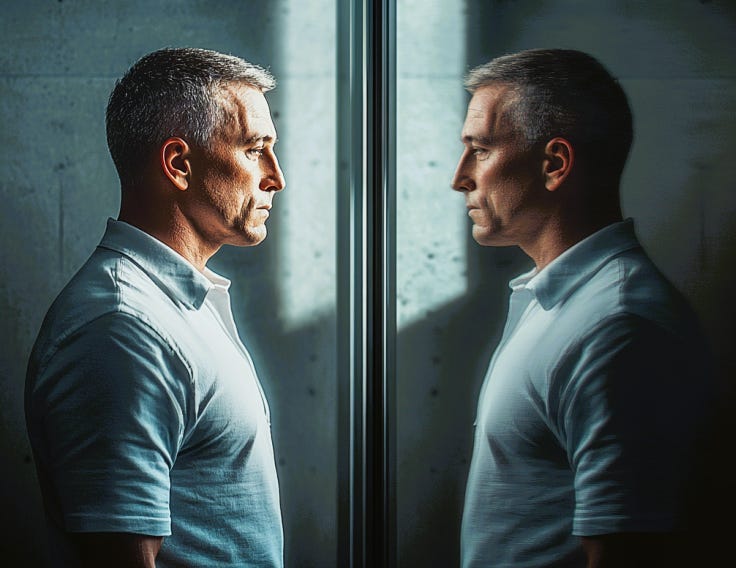
The Recorder’s role in the play is not that of a passive uninvolved observer - although if you were to ask any of the characters in the conflict they might certainly accuse him of being one. His is a crucial and challenging part - to bear witness without succumbing to prejudice. So that humanity may see its own reflection in the mirror - undistorted and unmodified. The Recorder believes it is only through witnessing its own patterns of self-righteousness, victimhood, tyranny, and conflict - that humanity has any chance of rising above it.
Which is why the two sides in the conflict in this story are simply labelled “Party A” and “Party B”. These generic placeholders are able to accommodate any kind of duality.
“Democrat and republican” | “Theist and Atheist” | “Men and women” | “White collar and Blue Collar” | “Rich and poor” | “Leaders and followers” | “Self and other” etc.
And the Recorder’s premise is simple: regardless of the dichotomy, the mechanism of conflict is always fundamentally the same.
Each side feels justified in the rightness of its own position
Each side draws a line of tolerance to mark the boundary between what it agrees with and what it doesn’t
Over time that tolerance wears thin and becomes a wall of ignorance of the other’s experience
The wall creates echo chambers - alternate realities that become drastically alien to each other
Over time suspicion of the other’s motives grows, eventually turning into paranoia
Paranoia precipitates a mutually-assured destruction
I hadn’t thought about that play in decades. Yet, it all came flooding back to me after my last article. Because I realized that I am, in a very real sense, a “recorder” in my own life. I have witnessed that same mechanism play out within me. The duality in humanity is identical to duality within the self. And it is there that I have been learning to cultivate the capacity to bear witness without succumbing to prejudice.
