
Blind Spot
Why wholeness cannot be known without shadow

“Hi Shiv,
I’ve been reflecting on your recent essay about the shadow, and it has left me with a question.
I’ve always thought of the shadow as something personal—the parts of myself I don’t want to acknowledge. But you seem to be pointing toward something much broader, almost as though the shadow isn’t just psychological but woven into existence itself.
If reality itself has a shadow, what does that actually mean?
How can something that is whole and complete possess a shadow? Isn’t a shadow simply evidence that something is missing or hidden?
I’m not sure whether I’m asking a psychological question, a philosophical one, or a spiritual one anymore.
I’d love to hear your thoughts.”
.
***
.
You are asking an existential question. What we call psychology, philosophy, and spirituality are just different ways of approaching questions of existence. One is based in anatomy and subjective experience, another in reason and objectivity, the last in metaphysical or universal perspectives.
In my essay, The Inevitable Stain, I said, “The shadow is woven into the fabric of reality.”
And you are right to wonder: How can something that is whole and complete possess a shadow? Isn’t a shadow simply evidence that something is missing or hidden?
So, let’s try a thought experiment.
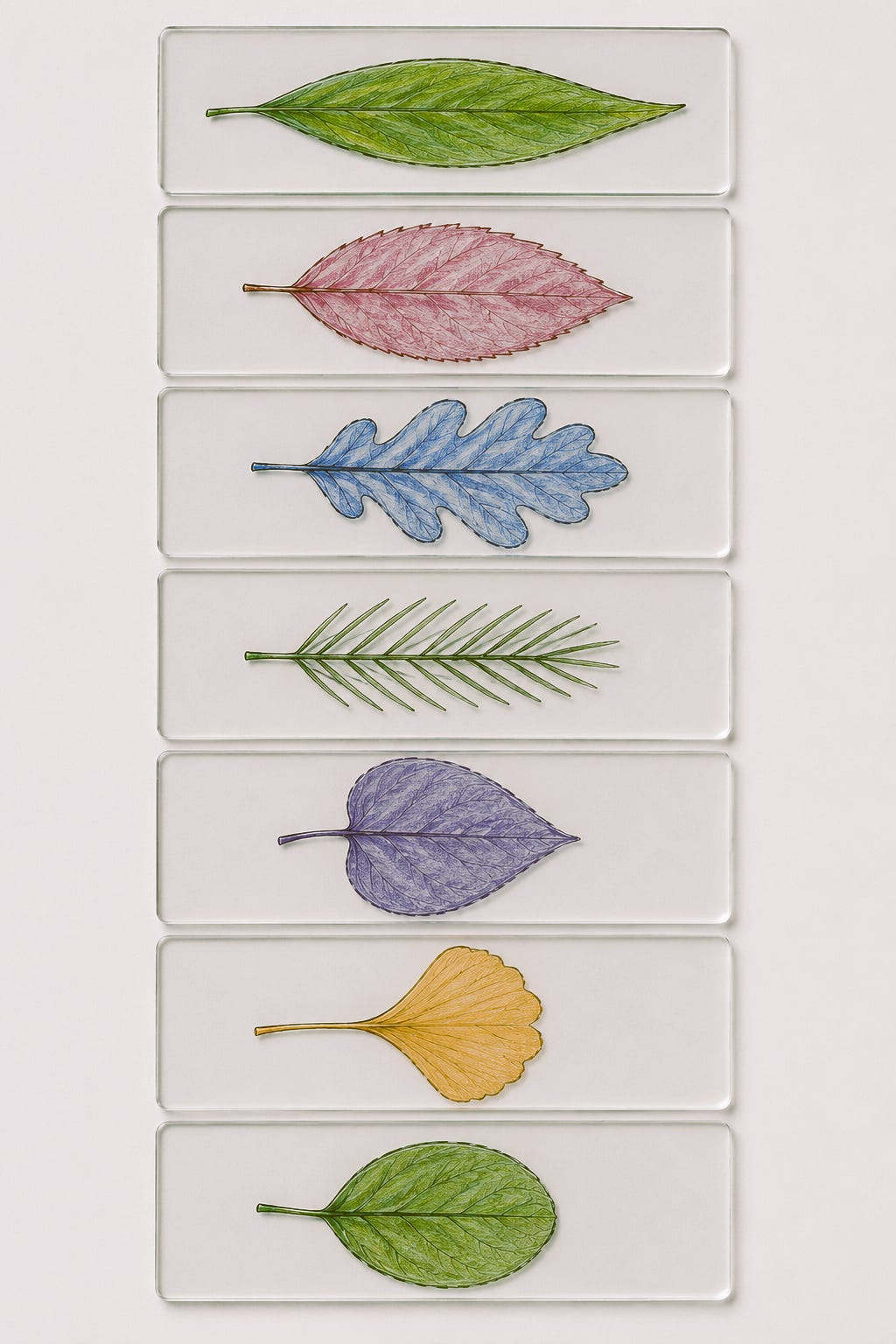
I want you to imagine you have a transparent glass slide in front of you. The kind you would put into a microscope to examine samples. And I want you to draw a leaf on that glass slide (and color it in) using some colored felt tip pens that you have at your disposal.
Notice that when you draw the front of the leaf, you cannot also draw the back of the leaf simultaneously. Its back is in the ‘shadow’. So take another glass slide and now draw the back of that leaf. And once you have finished, place that slide on top of the first. When you look at the two together, you will see a somewhat blurred image of the leaf.
Now, you have likely picked a certain shade of green for this leaf. But not all leaves are that shade of green. In fact, many leaves are not green at all. When you picked that particular shade of green, you excluded every other potential color that leaf could have taken. Those other colors are the leaf’s unrealized potential - its shadow. So, now use as many slides as necessary and redraw that leaf (front and back) - in each possible color. And once you are done, stack all the slides on top of each other.
Now, look at the image. All you will see is an indistinguishable leaf-shaped blob.
But wait.
You assumed a certain shape for this leaf when you drew it. And when you did, you excluded every other potential shape that leaf could have taken on. So now, use the infinite glass slides you have at your disposal to draw the leaf in every other potential shape it could have taken on (imagine you have an infinite amount of time to do this) - in each possible color - front and back.
What you now have is a stack of infinite slides with infinite images of ‘a leaf’ superimposed on one another - and when you look at the image now…all you see is an indistinguishable space. An emptiness. A void.
If someone were to walk by and look at the image - and they were asked the question: “What do you see?”
They would respond: “Nothing.”
But you know that what they are calling ‘nothing’ is really everything. It is every possible leaf in existence.
You tell this passerby that what they are looking at is every leaf in the world and they laugh at you. They refuse to believe you.
And so you say, “Here. I’ll prove it to you.”
