
True Equanimity
Why fetishizing calmness is a sign of spiritual infancy - and what equanimity is really about

“So epic. How do you distinguish this approach from equanimity? It seems to be the soul of equanimity as I understand it. I usually use that word rather than “non-dual” because non-dual is hilariously dualistic, but here you say equanimity is something you don’t cultivate. Is it an aversion to how other people confuse equanimity with tranquility?
I live in an area full of white “spiritual” people who talk in that “spiritual” voice and confuse peace and calmness, which is annoying, but I still know what peace really is—this ability you outline here to be present for ALL that IS, in my own mind and behavior and in the environment.”
(A comment on one of my recent posts Not Negative)
.
***
.
Spirituality has nothing to do with how one thinks, talks or behaves.
We humans, being social animals, are conditioned to attribute meaning and value based upon how favorably we will be viewed by the tribe. Once upon a time ‘being spiritual’ looked like making violent bloody sacrifices to the gods in the temple. Today it looks like meditation cushions, breathy tones and spaced out expressions of feigned tranquility.
Performative spirituality is a sign of spiritual infancy - an awkward albeit necessary phase. Much like children in kindergarten play games of pretend like “doctor and patient”, “mommy and baby”, “cops and robbers” - spiritual infancy is that phase in one’s development in which one roleplays “enlightenment”, “awakening” and such. Yet, just as being a doctor or a cop in real life is nothing like those preschool games we once played… spiritual maturity, and its attributes - equanimity, non-judgment, acceptance, compassion - is not what most imagine.
So, in today’s essay I’d like to address this attribute of equanimity and provide a more grounded view of what it really means. But first, since I’ve already introduced the idea of ‘spiritual maturity’ - I want to outline the various stages of spiritual development that seekers experience. And depending on what stage of development a person is in - that will capture the kind of seeker they are.
Stages of Development
I break the arc of spiritual maturity into 4 broad stages of development:
Spiritual Infant
Spiritual Adolescent
Spiritual Adult
Spiritual Elder
While these mirror the stages of human psychological development, I want to be clear that they do not necessarily map to it. For instance, there are many people who are senior in age but are still in spiritual infancy. And then there are those who although very young in years nevertheless display a high degree of spiritual maturity. I have no desire to delve into the whys and potential metaphysical rationalizations for this. Suffice to say that when you reflect upon your own life, you will have almost certainly encountered individuals who appear ‘wise beyond their years’ and vice versa. Yet, it still remains true that as a person ages in human years, they also mature spiritually. At what rate that process of maturity occurs will differ from person to person.
A spiritual infant is someone who, as I have already alluded to, is learning about their own being through a process of imitation. Just as children learn through mimicking their parents, spiritual infants rely heavily on teachings, doctrines, teachers, and practices, and derive meaning through imitation. This is the vast majority of humanity. Whether through traditional religion, or more contemporary new age teachings - the approach is universally the same. They seek an external authority to define for them what ‘spiritual’ means and believe that adhering to those guidelines is what makes them spiritual. (This is true for new atheists as well - who treat science as if it were a religion. Rather than adopting the spirit of exploration that is the hallmark of the scientific method, they instead accept its explanations as dogmatic truths.)
A spiritual adolescent is a seeker whose spirituality is tinged with rebellion and is steeped in conflicting motivations. It is the stage in which the seeker begins to grow suspicious of external authorities and starts to push back. They become drawn to more iconoclastic voices that are willing to “kill the buddha” - so to speak. Teachers like J. Krishnamurti whose words spur an ‘inner revolution’ or U.G. who openly tore apart traditional notions of enlightenment - appear to be like the Che Guevaras of the soul. There is an energy of protest and activism in the spiritual adolescent - just like there is in the psychological adolescent. Yet, that energy is still oriented towards a certain ideological view of spirit. There is still an aura of extraordinariness that surrounds it. Most seekers who are drawn to radical non-duality and extreme forms of Zen are in this stage of development.
A spiritual adult is a seeker whose spirituality has come ‘back down to earth’. The ‘spiritual life’ is no longer used as an escape from the material life - it is embodied. The boundaries between the two are not so rigid. They do not seek their identity in spiritual experiences. Meditating is as ordinary an activity as brushing one’s teeth. If they continue to read spiritual texts or associate with groups and practices - it is for pragmatic or social reasons and not because they harbor any fantasies of awakening. They chop wood and carry water - see mindfulness as a pragmatic necessity for maintaining homeostasis rather than an awakening technique. What clearly distinguishes the spiritual adult - is that their spirituality lacks an ideological flavor. It is more rooted in the phenomenological experience of their day to day.
A spiritual elder is one whose spirituality is indistinguishable from their daily life. In fact the idea of ‘spirituality’ itself feels reductive. Each moment of life is a spiritual experience regardless of what that moment looks like. There is only spirit - in and as everything, every happening, everyone including oneself. Every thought is spiritual, every emotion is spiritual. Matter is spiritual. Such individuals do not have a ‘spiritual life’ and a ‘material life’. There is only life. Indefinable and irreducible. They do not see things in binaries anymore - ‘me’ vs. ‘my life’, ‘now’ vs. ‘then’, ‘here vs. there’, ‘real vs. illusory’ - these dualities hold no relevance. The phenomenological nature of life has completely displaced the ideological as the seat of experience. Seekers who are in this stage of maturity are no longer ‘seekers’.
Awakening and Spiritual Maturity
Now, I want to make a certain distinction between spiritual maturity, which is a progressive and developmental unfolding - and an ‘awakening’, which is often a sudden point-in-time event.
An awakening can happen to anyone. It occurs entirely independently of the spiritual maturation process - yet it can impact that process in profound ways. Awakening can happen just as easily to someone in spiritual infancy as it can to a spiritual adult. Yet, when it does occur, it has the potential to accelerate the maturation process. Thus, awakening acts as a catalyst.
Let’s use the analogy of how a near-death experience can impact psychological maturity - to illustrate this relationship. I have known many near-death survivors - some who cheated death when they were very young and others whose own brush with death only occurred much later in life. Yet, in almost all these cases - one of the consistent outcomes, after the smoke settled, was a greater psychological maturity in facing life when compared to how they were prior to the experience. Coming face to face with one’s own mortality grounds a person in a very sobering way.
I often refer to awakening as a ‘near-life experience’. For it is a momentary and unexpected glimpse into a way of being so intimate - that the boundaries between self and life altogether collapse. And just like a near-death experience has the potential to accelerate psychological maturity - a near-life experience has the potential to accelerate spiritual maturity. For just as brushing up against death grounds a person - brushing up against life reveals how hollow the self-identity really is.
However, even catalysts aren’t perfect. Accelerating a process comes with side effects. And one of the side effects of awakening is that while it turbo charges one’s perception, it cannot do the same for the brain’s psychology and nervous system - which are left behind. These underdeveloped and unintegrated aspects then need to be gathered up and pieced together retroactively. Failure to do so results in all kinds of deviant and bizarre outcomes. One need only take a glance at the long list of highly gifted mystics and gurus, who nevertheless left a path of chaos, suffering and confusion in their wake because they failed to integrate the human personality and the animal nervous system into their expressions. These remained in a regressed state and so they acted out the tyrannical, abusive and narcissistic patterns of toddlers- who although ‘enlightened’, never grew up.
Attributes of Spiritual Maturity
We are all maturing spiritually.
Each and every one of us - regardless of whether we affirm the spirit or not. We have no choice. It is happening.
Whether one has experienced an awakening or not is irrelevant. Although, the experience is highly coveted amongst seekers for its accelerative qualities - it is not without its dangers and drawbacks, as I have already mentioned. What accelerates one day may lead to a stunting in the next. So, there is no “superior” way in which any of this unfolds. The way it happens is simply the way it happens.
Nor is there any implied hierarchy in the stages of spiritual development. Just like a human adult is not ‘superior’ to a human child - a spiritual adult is not superior to a spiritual infant. Each stage is perfectly appropriate and each stage carries its own charm. The naivete of childhood, the rebelliousness of adolescence, the sobriety of adulthood, the lightness of elderhood - each phase carries its own distinct flavor - just like the seasons.
There is no end game - no finish line to be reached. Just as we would not want our children to be in a hurry to grow up - there is no need for the seeker to rush maturity.
However, since I began this essay with the intention of addressing some of the attributes that are commonly associated with spiritual maturity - I feel like I have laid a sufficient foundation of why these attributes are interpreted so differently by seekers.
Equanimity
To a spiritual infant, equanimity looks like a Buddha statue - a faint hint of a smile, an unperturbed response to life no matter what occurs, evenness of temper and disposition. This is because in spiritual infancy one is perpetually seeking external cues and attempting to reorient one’s own expression by mimicking. These are much like the “white “spiritual” people who talk in that “spiritual” voice and confuse peace and calmness” that the commenter described living in her area.
The fact that most of the spiritual industry generally models this kind of behaviour - not just amongst seekers but teachers as well - is an indication that we, as a society, are still predominantly in an age of spiritual infancy. Yet, there has also been, in the past decade, a significant rise in the criticism of teachers, the industry at large, and its lack of ethical standards - which also suggests that we are gradually moving into a collective stage of adolescence.
Equanimity for the spiritually mature has nothing to do with how it appears. The word equanimity derives from the latin - aequanimitas - which is composed of the words aequus (equal) and animus (spirit - ‘that which animates’). In other words, true equanimity is the capacity to perceive the spirit in all things and all experiences equally.
It is what I alluded to in my article Not Negative - it is the capacity to view all phenomenological experience - whether a thought, an event, an emotion, a person, a sensation, a circumstance - as equally worthy of being. For if it wasn’t worthy of being - it simply wouldn’t be. It is not the form an event takes that justifies its existence. Rather it is the very spirit that sustains it and brings it into form, that does.
It is that spirit one honors. Not the form.
Which is why equanimity need not necessarily look like tranquility. It can also look like resistance, even rage.
Because one can honor the spirit of a thing while opposing its form. Just like a parent’s love need not look like permissiveness and they can love their child while establishing consequences - so also can one act out of reverence for the spirit while acting in a manner that holds its forms accountable.
For when one defers to the spirit and does not challenge its forms - that is a kind of bypassing. Just as when one opposes the form without acknowledging the spirit that animates it, it is also a kind of bypassing.
Take a look at the world around you and you will see the vast majority engaged in one of these two forms of bypassing. There are those whose lives are built upon a system of pathologically opposing anything they do not understand or agree with - and they do this by negating the spiritual value of those things and ‘othering’ them. Then there are those who, in an attempt to ‘see all beings as spiritual’, lapse into ethical ambiguity and cope by retreating into philosophy and abstraction.
Neither is equanimous - no matter how much they champion ‘equality’ for others, no matter how much they present as tranquil and peaceful on the outside.
True equanimity has nothing to do with presentation, performance and posture. It is an equality of perspective, of approach, of value, of judgment.
If the action emerges from a reverence for the spirit animating the other, then that action can look like tranquility or resistance, peace or conflict. Opposing the form does not negate its spirit - it can also affirm it.
Yet, this kind of nuance is lost on those who are still at the stage of infancy - for they have no direct awareness of spirit as yet. Theirs is a binary world of ‘spiritual and non-spiritual’, ‘awake and asleep’, ‘enlightened and unenlightened’. And so they have no choice but to cling to the forms that they expect to see while rejecting those that do not conform with their image.
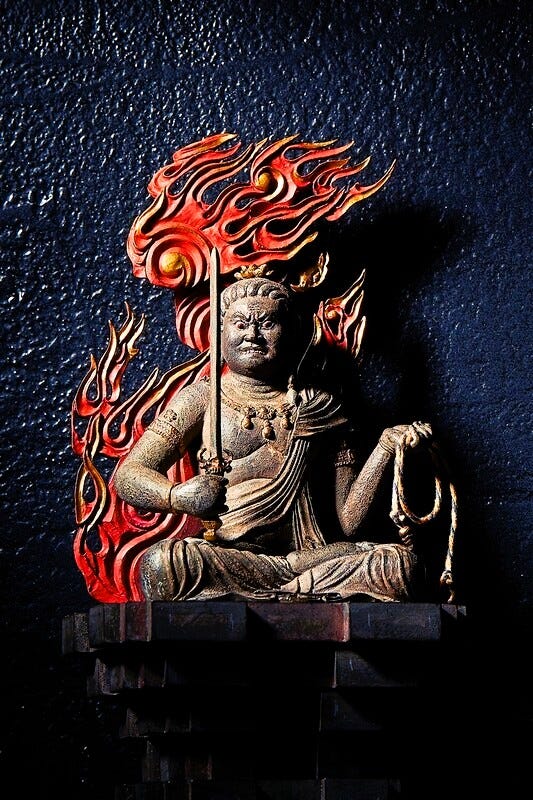
Jesus overturned the tables of the moneychangers and made a whip of cords to drive the traders out of the temple.
When converting the Kassapa fire-priests, commentaries claim the Buddha used displays of rhetorical power and ‘wrathful compassion’ to humiliate the priests’ pride - causing them to ‘sweat and tremble’.
Grace can be calm or it can be fierce. The tools it uses to express itself are as varied as our capacities for emotion.
Yet, the core remains the same - a clear unobstructed view of the sacredness of being - the animator of all that is - in all its myriad and often contradicting forms. And an action that emerges from a reverence for that.
Equanimity is equality of spirit.
It is expressed as an ontological shift, not a behavioral one.
It resolves all the false binaries we use to construct our narratives of the world and the identities we struggle to defend.
It reveals one being. One moment. One happening.
And every thought, word, and action that then emerges - regardless of its form - is but an expression of that same singularity - and a tribute to the same.
This is so clarifying as a definition of equanimity, "Equanimity for the spiritually mature has nothing to do with how it appears. The word equanimity derives from the latin - aequanimitas - which is composed of the words aequus (equal) and animus (spirit - ‘that which animates’). In other words, true equanimity is the capacity to perceive the spirit in all things and all experiences equally."
Thank you for this. This explains why I see the magic of "that which animates" everywhere and, yet, in my daily life, I still sometimes get angry, I'm still sometimes an asshole. Those are not "good" of course, but I see now that it isn't really reasonable to expect to ALWAYS be calm, loving, peaceful, etc, at least not while in human bodies.
Interestingly, this makes me think the biblical term, "iniquity," which means "unequal" would be the opposite: it would be NOT perceiving the spirit in all things (and thus opening the door for "sin.").
Thank you so much for your writing. Worth every penny.
I spent all of 2025 as a spiritual adolescent but feel like I am slowly easing into the adulthood stage now. Politics and the news no longer ruffle my feathers like they used too which is a big sign of growth to me. I just don't take anything too personally anymore. My growing confidence that I will act in alignment with my beliefs regardless of the actions of others and my external circumstances is very freeing. I can't control the world, but by managing my own emotions better the world has become progressively easier to tolerate with each passing day. Foregrounding forgiveness and understanding at all times is way easier now than it was a year ago . Things were pretty messy at first because my initial enlightenment experience was unintentional/drug induced and pretty destabilizing to my sense of self looking back but I rode it out and kept practicing and it all feels so much easier now.